In Blood & Plunder each Nationality has certain distinctives that make it interesting and unique. Within each Nation, various Factions let you play very different styles of armies (all historically based). In this article, we will look at what makes the Native American Nation unique in Blood & Plunder, and then give a quick summary of each of the several Native American Factions. We are constantly adding new detailed Faction Overview articles as well if you’re looking for more detailed information on a specific Native American Faction.

When you start playing Blood & Plunder, one of the first things you will need to decide is which nationality (or nationalities) you want to play. Hopefully, these articles will give you an idea of what makes each nation special, what options you have within that nationality, and which factions would be the most fun for you to play.
This article was originally written in 2020 but was revised in early 2024 to cover all Factions from the Rule No Peace Beyond the Line expansion (where Native Americans were introduced to Blood & Plunder), the Fire on the Frontier expansion, and the Raise the Black expansion.

What Makes the Natives Special?
Well, almost everything about them! The Native Americans are the most unique set of Factions within Blood & Plunder. Playing any one of them feels very different than playing the “normal” European Factions. The Natives play by a whole different set of rules! So where do we start?
First, there are two sides to the Native Americans: the “Caribbean Natives” representing the indigenous peoples from the Caribbean Islands and the “Spanish Main” of Mexico, and Central America, and the “North American Natives,” representing the people inhabiting the North American continent. The Caribbean Natives in Blood & Plunder are more focused on bows, poison, and avoiding melee combat, and generally are more focused on the 17th century. The North American Native Factions are much more comfortable with flintlock muskets and use less archery.

Unique Tactical Options for the Natives
The Natives are fast, sneaky, and are hard to hit. If they stay at range, they have ways of staying hidden. If they get charged, they can often just slip away before coming to blows. They have access to bows and can shoot arrows quickly but very few hits will kill the enemy. But with care, the Natives can harass their enemies until their fighting effectiveness is destroyed and then rush in for a brutal massacre before slipping away again.
On the flip side, units in the Native American faction don’t enjoy getting killed at all! With poorer-than-average Resolve, Native units can be bogged down with Fatigue, or fall easily to prolonged melee combat.

The Native Factions tend to play better on land than at sea, but both theaters of games are enjoyable. With no access to the larger European-style ships, the Natives will use fleets of small Canoes along with one or two larger dugout Piraguas when fighting at sea.
Tricks make the Natives interesting and unlike any other nationality in the game. All the tricks make them the most rule-heavy group of factions in the game so they’re a bit difficult to begin with.

The Caribbean Native Factions
The Native Americans have a wide variety of Factions available to explore, with variations on a few of them. Let’s look at the Caribbean-style Natives first, then the North American Natives.
There are an impressive 18 different Native factions in Blood & Plunder and a couple of different variations on several of those from different expansion books.
Caribbean Tribes

This is a very well-balanced faction where the Native strengths and weaknesses are both on display. On the one hand, this faction has access to special Poisoned Arrows equipment which makes their enemies paranoid and ineffective by piling on Fatigue. This Faction probably has the best bow rules in the game. On the other hand, their already weak Resolve is further tested by Special Rules that make all gunpowder weapons especially terrorizing against the Caribbean Tribes!
This faction has access to lots of bows, some melee units, and very few muskets.
As is true for most Native factions, commander options are limited. Commanders buff the unit they are attached to, but the Native commanders tend to be less effective in leading their entire force than most European leaders.
The Caribbean Tribes faction is found in the No Peace Beyond the Line expansion.
Caribs (Kalinago)
The Caribs have a very similar set of rules that define their play style as the Caribbean Tribes. They don’t like getting shot by gunpowder weapons but they also have the Poisoned Arrows to respond with. Their unit selection includes a stouter and more well-rounded African Warrior core unit instead of the melee Warrior unit found in the Caribbean Tribes. Bows are still the main emphasis in this faction.
The Caribs also have the Ruthless ability applied to all their units, giving them a bonus when attacking enemy units with Fatigue (the Spanish signature ability). The Cunning ability is also applied to all Carib units, allowing them to retreat further than normal after their units become Shaken, which helps them survive a melee that has gone wrong!

The Caribs (Kalinago) faction is found in the No Peace Beyond the Line expansion.
You watch a quick review of the Caribs faction on Victorum Gaming YouTube channel.
Darien (Cuna)
This faction is very focused on quick and brutal melee strikes. While it requires every unit to be equipped with bows, the Darien faction has a very different emphasis than the previous two factions. With only the basic (but flexible) Warrior unit available as the core of your Force, army building is relatively simple in this Faction.

With deadly Thrown Weapons and rules to help you move quickly and charge your enemy effectively, this faction is all about striking your enemy hard in hand-to-hand combat. This faction also lacks the fear of gunpowder weapons.
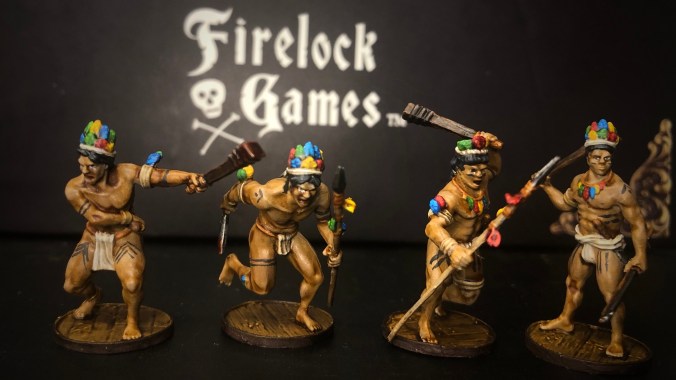
Leadership options are still limited compared to most of the European factions but there are 3 different historical commanders for this Faction in addition to the standard generic leader options.
The Darien (Cuna) faction is found in the No Peace Beyond the Line expansion.
South American Tribes
This Faction focuses on two of the Natives’ strong points: Poisoned Arrows, and being hard to hit. This is a great Faction to start with if you want to try the Caribbean Natives in Blood & Plunder (or if you want to win a tournament!)

The South American Tribes have access to the best archer unit in the game along with the Poisoned Arrows equipment that tends to multiply the Fatigue they apply to their enemies. Their other Faction rule makes them more difficult to shoot if they’re in cover. The combination of deadly poison, elusiveness, and no fear of European weapons makes this faction really good. They have less access to strong melee units but I find that if you can dump enough poisoned arrows on your enemy, one good melee unit can wipe out flustered Europeans in short order. The South American Tribes Faction is a favorite!

The Elusive Special Rule doesn’t provide any benefit while in a boat or ship, but the Poisoned Arrows equipment can be very deadly at sea if you shoot enough arrows, making this one of the better (or less bad) Native Factions to use in a sea game of Blood & Plunder.

They only have one historical commander available and he’s not particularly amazing but they don’t need an amazing commander because they’re already that good.
The South American Tribes Faction is found in the No Peace Beyond the Line expansion.
Golden Island Tribe
Last, for the Caribbean-style Native American Factions, we have one “Legendary Faction”. The Golden Island Tribe is the personal force of King Golden Cap. The Golden Island Tribe is a variation of the Darien Faction. This force is very proficient in fighting Europeans and it can even include some English and French models in their army. They are the toughest Native faction in the game and King Golden Cap’s unit is nearly impossible to route.

This force has to include this high-cost commander so it’s best when you have a chance to play games on the larger end of things.

150 Point “Budget” Golden Island Tribe Force
The Golden Island Tribe Faction is found in the No Peace Beyond the Line expansion.
North American Native Factions
Now we move into Factions representing Tribes in North America, and there are a lot of them!
Iroquois (No Peace Beyond the Line)
This Faction is included in No Peace Beyond the Line, Fire on the Frontier, and Raise the Black. Each version of the Faction is a bit different, tracking their changing tactics as their contact with Europeans increased over the years. Their unit selection changes between versions of this Faction, but their basic strengths remain the same: strong access to gunpowder weapons, and hardiness in melee combat.

Not only are the Iroquois unafraid of European weapons, they have adopted muskets as a primary weapon. This faction has less emphasis on bows and more access to cheap Warriors with muskets.
Their War Cry will often break their enemy’s Resolve when they charge and even when the Iroquois lose their will to fight, they’re tricky and cunning. Their faction rules help them withdraw battered units quickly to reform them into functional units again before they’re destroyed.
Iroquois (Fire on the Frontier)
This version of the Iroquois focuses on the Braves and Young Braves units instead of the original “Warriors” line of units released in No Peace Beyond the Line. Their basic strengths of solid musketry and sturdiness in melee combat still apply.
This version of the Iroquois also includes 2 Faction Options that let you play as either the Seneca or Mohawk, providing another level of specialty! There are two unique Commanders available to this version of the Iroquois, including the mighty Black Kettle (very strong commander)!

Iroquois (Raise the Black)
The Raise the Black expansion, includes additional Force Options so you can play as any one of the 5 Tribes from the Iroquois Confederacy: Mohawk, Seneca, Onondaga, Cayuga, or Oneida. This Faction adds one more unique historical commander.
Wabanaki (No Peace Beyond the Line)
The Wabanaki also appear in all 3 major expansions to Blood & Plunder, starting with No Peace Beyond the Line.
With the War Cry melee bonus and Skirmishers ability (charge or shoot, then fall back as a free action, the Wabanaki is a very “skirmishy” faction. Their unit options emphasize muskets and melee with archery being more limited.

Wabanaki (Fire on the Frontier)
This expansion provides a major update for the Wabanaki, replacing the unit selection with the “North American” Braves, Young Braves, and Pnieses, which are slightly better in melee combat.
This faction has a unique ability to have its units make a full move after setup and before the game begins, in addition to their Skirmishers specialty. They can also utilize size 2 Ships, which is a big deal for Native Factions!
Like the Iroquois in Fire on the Frontier, this version of the Faction has 2 Force Options, letting you specialize as the Abenaki or Penobscot nations within the Wabanaki Confederacy.

Wabanaki (Raise the Black)
This version of the Wabanaki expands it by offering options for all five of the tribes within the Confederacy: Abenaki, Micmac, Maliseet, Penobscot, and Passamaquoddy.
Northeastern Woodland Tribes (No Peace Beyond the Line)
This is a catch-all faction for the many tribes in the Northeastern part of North America. No Peace Beyond the Line introduces this faction, and there are also variations of it in Fire on the Frontier and Raise the Black.
This is a pretty generic Native American Faction with some Special Rule bonuses that apply to melee combat. This faction has access to King Philip, a “Legendary” Native Commander.

Northeastern Woodland Tribes (Fire on the Frontier)
This version of the Faction replaces the main core units (Warriors and Young Warriors) with the North American Braves and Young Braves. It also adds a solid unique Commander option in Kancamagus. Kancamagus has a Vendetta: English and Cold Blooded which can make him a powerful opponent.
Northeastern Woodland Tribes (Raise the Black)
Retaining the basics of the previous iterations, this version allows size 2+ ships, which are usually unavailable to Natives. This gives them some really interesting options at sea.
Southeastern Woodland Tribes (No Peace Beyond the Line)
A close cousin to the Northeastern Woodland Tribes, this Faction is a catch-all for many tribes living in southern North America. With less early and consistent contact with traders than the Northern Tribes, it focuses more on archery and brutal finishing charges.

Southeastern Woodland Tribes (Fire on the Frontier)
Again, this faction gets some unit upgrades in Fire on the Frontier, but retains the same Faction rules which boost their archery capabilities.
Westo (No Peace Beyond the Line)
This is a VERY strong faction, representing one of the more aggressive Southeastern Woodland Tribes. When you play well, the South American Tribes can sometimes be overly strong. If you find your friends not wanting to play with you anymore, this is a slightly scaled-back version of that style of force. They get solid melee bonuses with War Cry and they have the Ruthless ability that inspires their troops if the enemy begins to waver. They have strong access to melee, muskets, and archery, but no Poisoned Rrrows.

Westo (Fire on the Frontier)
This later version of the Westo improves this musketry a bit and gives access to those late 17th/early 18th Native units. A strong faction, but a little sad that it has no unique Historical Commanders.

New England Tribes
Focusing on the several smaller tribes involved in King Philip’s War in 1675, this faction is very fun. It has both a variety of Force Options and a large number of unique Historical Commanders. Overall Faction rules focus on skirmishing bonuses and deadly charges with Thrown Weapons. Force Options with additional flavors include Mohegan, Wampanoag, and Narragansett.

The New England Tribes Faction is only found in the Fire on the Frontier expansion.
King Philip’s Alliance

King Philip’s personal Faction has lots of unit options and some great Faction rules. Many focus on staying elusive while on raids and making a decoy distraction during the first turn of the game. These special scenario rules can be very entertaining! This is one of the two Legendary Faction in the Native American Nationality.
The King Philip’s Alliance Faction is part of the Fire on the Frontier expansion.

Creek
The final 6 Native Factions in Blood & Plunder focus on the action happening in the early 18th century in the American Southeast.
This is one of the better Native Factions for focusing on musketry. With high-quality guns and the Elusive Special Rule, these Braves can afford to hide in the woods and pick off their enemies, sufficiently weakening them to move into melee combat.
The Creek Faction is in the Raise the Black expansion.

Chickasaw
This is really the most “elite” Native Faction. They can include the Veteran “Pnieses” unit as a Core Unit. They also have a higher chance of being the Attacker in a scenario, meaning they are more likely to be able to use their “Lay in Wait” ability that always throws an opponent off a little bit. You’ll likely have a smaller force than unusual, but this faction is quick, deadly, and has some real advantages going into a scenario. The “Spartans of the Low Mississippi!”
The Chickasaw Faction is in the Raise the Black expansion.

Tuscarora
The Tuscarora were known for their elaborate fortifications, and this Faction rewards you for using wooden fortifications like Palisades and Blockhouses. They’re really good in melee combat, and they are hard to beat! It offers more unit options than average, including the interesting and highly customizable “Renegadoes” unit.
The Tuscarora Faction is in the Raise the Black expansion.

Choctaw
The Choctaw were primarily allied with the French in Louisiana, and this Faction shares one of the main French rules in Blood & Plunder: the free move once per round. You can do some really fun tactical tricks with this ability and it feels very sneaky and Native! With a unique ability to downgrade Muskets from Primary Weapons to Sidearm Weapons for a substantial discount, this is a great faction for running a high model count. Very unique Faction
The Choctaw Faction is in the Raise the Black expansion.

Cherokee
This is a flexible faction, partly because of its “Early Contact” and Late Contact” Force options. The Later Contact rules give all units the Tough Special Rule which is massively helpful in managing Fatigue on Native units.
The Cherokee Faction is in the Raise the Black expansion.

Yamasee
Lastly, we have a Southeastern tribe that has some Spanish flavor. The Yamasee were fierce raiders and they welcomed many escaped Africans into their tribe. With Terror, Ruthless, and the ability to bring African Warriors with strong firearm capabilities, this faction has a very different and aggressive flavor to it.
The Yamasee Faction is in the Raise the Black expansion.
Non-Native Factions that Feel Like Native Factions
There are three “Unaligned” Factions that are not technically Native American but they play very much like Native Factions in Blood & Plunder, so we are including them here.
Black Caribs

This faction represents escaped slaves from Saint Vincent Island. They’re tough, quick, fast, and hard to hit. They pretty much have all the Native special rules except the Poisoned Arrows. This faction has only the single African Warrior unit available as a core unit so there isn’t a ton of room for creativity in building this force. But there are lots of options for customizing the African Warrior unit.

Model point cost is high in general, so this Faction will be a small force, but elite.

The downside to playing this force is you’ll need to buy and paint a lot of the same unit!
The Black Caribs Faction is in the Raise the Black expansion.
Miskito Zambo
This Faction represents a tribe that became very mixed with escaped Africans in Central America and the Faction rules reflect that. These guys are deadly raiders and they have a bonus to the pre-scenario roll to determine Attacker which is very rare for a land-focused faction! Strong abilities in musketry and mobility.
The Miskito Zambo Faction is in the Raise the Black expansion.

Maroons
Finally, we have the Maroons from the Raise the Black expansion. This faction also has a lot of the Elusive, Quick, and Hidden abilities you come to expect from the Native Factions. With some fun Force Options and Legendary Queen Nanny available as a Commander, this is a deep and rewarding faction to play.

The Maroons are very rules-heavy but very deadly. They even get to choose to force a scenario to use the Night visibility rules if they are the Attacker.
Buying Into the Native Americans in Blood & Plunder
You’ll need to first decide if you want to focus on a “Caribbean Style” Native Force, or a North American style Native Force.
For the Caribbean and South American Factions, you can either start with the resin or metal 25 model Native American Starter Box, or you can go with the hard plastic Native American Unit Box if you like creating your own miniatures.

At $99 for a box of 25 minis, the resin one-piece minis are more expensive, but very high quality and don’t require any assembly. You’ll get 8 Warrior Archers, 8 Young Warriors, 4 Warrior Musketeers and 4 African Warriors.
With the hard, multipart kits, you’ll get 12 minis for $29, or 25 for $58, providing considerable savings, but requiring a lot more work. Fair warning: the Native American Unit Box is probably the most difficult to assemble of the Firelock kits. You can arm them with a variety of muskets, bows, clubs, machetes, and pistols. If you go with the hard plastic kits, I would recommend purchasing the Native American Nationality Bundle that includes 2 unit boxes and the one piece resin or metal Native Commander model. Its a good deal and you want that distinct commander model. The King Golden Cap model is a great addition as well.

You’ll want between 24 and 40 models to have the freedom to build forces of up to 200 points.
The No Peace Beyond the Line expansion book is the expansion you’ll want for playing Caribbean Natives.
If you want to focus on North American Native Tribes, you’ll want to pick up a selection of:
- Braves
- Young Braves
- Pnieses
- Native American Woodland Commander
- Possibly the King Philip Legendary Commander
The mix of models you’ll need will largely depend on which Tribe you want to focus on, but Braves are the most multipurpose and basic of all your options.

There is currently no bundle or box for the North American Native models, but rumor has it that its in the works!

For the North American Tribes, the Raise the Black expansion has the most options for you. The smaller Fire on the Frontier expansion is very focused on the the Indian wars of the late 17th century and has a lot of great commanders and North American Tribes Factions as well.
Final Thoughts
The Native Americans are a very dynamic, unique, and interesting set of factions in Blood & Plunder. All the Special Rules that make them interesting make them one of the harder factions to learn but once you wrap your head around several of the rules that apply to the Natives, it’s not too difficult.

The variety and quantity of Native Factions available to play in Blood & Plunder is amazing! It’s refreshing to see Native Americans represented well and with respect for the history in a war game. There are tons to explore!
Here are a couple of practical perks of playing as the Native Americans in Blood & Plunder:
- It’s easy to collect minis. There aren’t that many different units and models so you can get an army together fairly quickly.
- You can easily move between the different Native Factions without having to buy more and different models.
- Since people play Natives the least of all the Nations in Blood & Plunder, chances are your opponent won’t be very familiar with Native tactics and strengths, giving you a competitive edge!

Hopefully, that gives you a decent overview and comparison of how the various Native American Factions in Blood & Plunder. While Blood & Plunder is primarily a “pirate game,” it offers opportunities to play as some of the many Native tribes and peoples that play a huge part in the story. These tribes range from Canada, to Carolina, to Florida, to the Caribbean Islands, to the isthmus of Darien to the Brazilian jungles!

Additional Recommended Reading
- Links to many Nation and Faction Overview Articles and Videos at the Ultimate Guide to Blood & Plunder Nations and Factions
- Read all about the Spanish Nation and Factions
- Read all about the English Nation and Factions
- Read all about the French Nation and Factions
- Read all about the Dutch Nation and Factions
- Read all about the Pirate Unaligned Nation and Factions
- Read all about the Minor Powers “Nation” and Factions
- Read this detailed overview of the Caribs Faction
- Watch this video review of the South American Tribes
- Read this detailed overview of the South American Tribes Faction
- Read this detailed overview of the Black Caribs Faction
- Read this detailed overview of the Iroquois Factions
- Read this detailed overview of the Maroons Faction
Pingback: The Peripheral Power Factions | Blood & Pigment
Pingback: Blood & Plunder Birchbark Canoe - Blood & Pigment
Pingback: Fast Boarding - Blood & Plunder Sea Force Building Pt 2
Pingback: Native American Call to Arms! - 2024 Summer of Plunder - Blood & Pigment
Question:
NPBTL have a typo?
Under Southeastern Woodland Tribe (in NPBTL) the commander choice are “any Southern Tribes commander or Matamaha. But under the actual native American standard commanders choices the SE Woodland tribe is listed under Northern Tribe commander and not the Southern tribe choices. Which is the correct interpretation for NPBTL commander choice….northern or southern tribe commanders? Michael
Yes, that does look like an error! The Fire on the Frontier expansion consistently uses Southern Tribes Commander for the Southeastern Tribes faction so I would go with that.
Pingback: Native American Call to Arms! - 2025 Summer of Plunder - Blood & Pigment