It may come as a shock to some, but the use of hand-thrown, explosive weapons during the age of piracy actually played a crucial role in maritime warfare. Pirates, renowned for their ingenuity and resourcefulness, employed a variety of explosive devices to devastating effect. From simple grenade-type “bombs”, to lethal “fire pots” and even smoke-filled, vomit-inducing containers. These hand-thrown explosives provided a formidable arsenal to wreak havoc on the decks of enemy vessels.
In this article, we delve into how these weapons play into the historical pirate miniatures game of Blood & Plunder. We’ll cover the basics of rules and some ways for you to add explosive weapons to your tactical repertoire.

History of Handheld Explosives
Among European military units, the first grenadiers were among the French. The word “grenade” was first recorded in 1536, during records of the siege of Arles in southern France. They were used by forces under King Francis I. These early grenades were made of glass globes, jars, kegs, and firepots. In 1665 we have a historical reference to explosives carried in a pocket called a grena-diere. By 1667, the French army had regular companies of grenadiers. They were quickly copied by the English. The first description of grenadiers for England is this quote from
His Majesty and a world of company were in the field; and the whole army in battalia; a very glorious sight.. Now were brought into service a new sort of soldiers, called Grenadiers who were dexterous in flinging hand grenadoes, every one having a pouch full. They wore furred caps with coped crowns like Janizaries, which made them look very fierce, and some had long hoods hanging down behind as we picture fools. Their clothing being likewise piebald, yellow and red.
-John Evelyn 29th June 1678 Hounslow Heath
By the mid-17th century, various types of explosives, or “fireworks,” were commonplace in naval warfare. In Chapter 6 of The Sea Rover’s Practice, Benerson Little describes the three main types of explosives and how they were used by the Buccaneers.
Handheld explosives were also a key weapon in storming fortifications. Smoke was used to cover an advance, fire was used to destroy wooden fortifications, and grenades were lethal in clearing a wall before climbing over. These explosives are recorded as being used by buccaneers, pirates, militia, and army forces throughout the 17th and 18th centuries.

Rules References for Explosives in Blood & Plunder
The rules for Explosives are split up in a few places in the Core Rules book. Here are the key sections:
- General Weapons Rules for Explosives and a breakdown of the Types of Explosives is on page 115.
- Rules for Making an Attack with Explosives is on page 54
- Critical Damage Tables for resolving things like fires in Structures, Ships & Boats start on page 64

Summarized Explosive Rules Breakdown
- Explosives are considered to be Small Arms for rules purposes and attacks resolve using a Shoot Action.
- They do not gain Reload markers, meaning you can throw them with every action.
- They cannot be used for Defensive Actions.
- They cannot be used to target rigging.
- All Explosives have a max range of 5”.
- Explosives can be thrown horizontally or vertically, so don’t forget they can be thrown OVER obstacles or impassible terrain.
- They do not require LOS to the target.
- They do not take range penalties.
- They do not drift or go off target when thrown. A “miss” is reflected by not scoring Hits.
- Units must choose the type(s) of Explosive they are equipped with before the start of the game.
- Units may be equipped with a mix of Explosive types.
Misfires and the Dangers of Explosives in Blood & Plunder
When you use an Explosive during an attack, you have one of two options:
- If a unit with Explosives uses 2 actions to make an attack with them, there is no chance of misfire.
- If a unit with Explosives uses 1 action to make an attack with them, roll one d10 for each model attacking with Explosives. If that roll is 1-2, the explosive detonates prematurely.
Roll the appropriate number of dice for Hits and/or apply any other effects of the explosive to the attacking unit instead of the target unit. Roll a Fatigue Test for any hits and Casualties as usual.
This means if you rush an attack you have a 20% chance of an Explosive hurting your own unit rather than the target. This is fitting for such volatile weapons that are largely gunpowder-driven. Will discuss this more a little later under each specific type of weapon.

Types of Explosives
There are 3 types of Explosives in Blood & Plunder.
- Grenadoes: Primitive versions of modern grenades.
- Firepots: Similar in concept to a Molotov cocktail
- Stinkpots: Small pots or bottles filled with some smokey, stinking substance whose fumes would disorient or incapacitate enemies, even causing them to vomit and retch. Conceptually similar to a modern CS gas grenade.
Grenadoes
Grenadoes, also known as grenades, were powerful explosive devices that played a significant role in warfare during the Golden Age of Piracy. These compact spherical projectiles were typically made of metal and filled with gunpowder. Equipped with a fuse, they were ignited and thrown by hand toward enemy targets. Upon detonation, they unleashed a devastating explosion, causing widespread shrapnel damage and creating chaos within enemy ranks. The effectiveness of grenadoes in breaching defenses and inflicting casualties made them a formidable weapon of choice for pirates and military forces alike.

Summarized Grenadoes Rules Breakdown
The full rules for Grenadoes are on page 55 of the revised Core Rules, but here is a quick summary:
- Grenadoes do 3d10 damage per attack.
- The target number for the Shoot Test is 7+, and no additional bonuses can be applied to it (e.g. Special Abilities or penalties). This means that Special Abilities or bonuses from taking Dedicated Actions cannot affect the target number. This translates to a 40% chance of success on each die.
- If you roll any natural 10s for a Shoot Test, an additional d10 may be rolled for each 10, to attempt to score additional hits. Natural 10s rolled with the bonus dice do not trigger any additional dice.
- A unit Hit does not get the benefits of Cover (or Hard Cover) when taking Shoot Saves. This means EVERY Save requires a 9+ (e.g. 20% of succeeding at a Save).

Strategic Analysis of Grenadoes
- They do 3D10 damage which makes them 3 times as “effective” as a pistol, musket, or bow. In military terms, this is known as a force multiplier. In game terms, consider that it costs 2-8+pts per model to add them to your force. When you get to close range you are essentially getting the firepower of 2 additional models for only 2 points instead of 4-16pts.
- Because they have no Reload markers it makes them more efficient on Inexperienced units who don’t get as many actions and need to reload. They are also great in combination with Brace of Pistols that also do not earn Reload markers.
- These weapons are also EXCELLENT for boarding actions or assaulting Fortifications. First, the enemies are tightly grouped and effectiveness is maxed out. If two units are in a section the enemy has to split hits multiple hits between the units, meaning they will have to roll additional Fatigue Dice. Second, and more importantly, models lose all benefits of Cover. If you are using the Fortification rules in Fire on the Frontier, they can be a game changer. Units in hardened Fortifications like Garrison Houses or Stone Towers have a Save of 3+ for Superior Cover reduced to a 9+.

Tactical Suggestions for Using Grenadoes
- Using a single action only has a 20% chance of failure occurring. Being a Dauntless personality type, this is an acceptable risk in my opinion. Especially, if it’s early in the game when you still have Fortune Points remaining. And if you are using lower-cost units like Pirates or melee weapons only Marins or Sea Dogs it hurts less. Late game you may want to use more caution.
- Many people subconsciously like to throw grenades into the center of a unit to make sure you hit as many models as possible. That’s a “mental block” thing. In reality, you don’t have to have LOS on even a single model for it to affect the whole unit. You only have to get to the edge of the base of the nearest model for things to kick in. It’s not an AoE template, that’s for Smoke.
- Because Grenadeos change the target unit’s Shoot Save to 9 you should target the enemies with the lowest Shoot Save to make them the most effective.
- Targeting units worth the most points is also an effective way to do the most damage to an enemy force.
- Grendaoes are effective, not just at sea, but on land. Especially, if you are playing in a game that is likely to involve a lot of thick cover or heavily wooded/jungle terrain.
- In games with a large number of buildings, grenadoes are also an excellent option as you can throw a grenade over the top of any structure up to 5” tall. Use the corners/backsides of buildings to hide out of LOS when making attacks.
- Once you are in Melee or you can’t use grenadoes, so use them BEFORE an enemy gets too close.
- There aren’t any base Units with the Skirmishers that can take Grenadoes. However, you can use a Commander with Guerrilla Commander to add Skirmishers to units and gain some unique tactics. You can Move out, throw and Move back into cover or out of LOS.

Commander Suggestions for Grenadoes
There are a few commanders that offer the Skirmishers or Guerrilla Commander (which gives Skirmishers for free) special ability. This gives you the ability to duck in and out of cover to throw Explosives.
- David Nassy (25pts) – Dutch
- Francisco de Fuentes de Galarza (28pts) – Spain = can be paired with Soldados
- Experienced Standard French Commander (10pts)
- Seasoned Standard French Commander (20pts)
- Experienced Standard Spanish Commander (10pts)
- Seasoned Standard Spanish Commander (20pts)
- Also, there are several French Factions that give a single unmounted Unit a free Move at the end of their activation. This gives you a better version of Skirmishers that lets you attack and then move in a different direction to get away from an enemy and possibly out of Charge range.

Firepots
Firepots are early precursors to the more widely known Molotov Cocktails. By filling glass bottles, clay pots or other containers with combustible substances such as pitch, tar, and flammable oils, pirates could create lethal projectiles. Designed to be ignited and hurled at enemy targets, firepots unleashed devastating infernos upon impact, causing chaos, panic, and widespread destruction.

Summarized Firepots Rules Breakdown
Firepots work like Grenadoes except:
- The target number is 8+ regardless of the unit’s Shoot score.
- They do not score additional hits on Natural 10s.
- A unit hit by a firepot must roll an additional D10 on its Resolve/Fatigue test
- If thrown at a unit in a Structure (ships are Structures) and at least two 10s are rolled; it catches fire and takes a Fire Critical Hit. See Critical Damage Tables for Fire effects on pg 64-66 (summary below)
Rules for Fire on Structures

The full rules for Fire are on pg 64 under Building & Fortification Critical Damage
- The section attacked catches fire on a Critical Hit location of 8-9 for Buildings and a 9 for Fortifications.
- Any unit that begins an Activation in a burning Section must make a d10 Resolve Test. A failed test causes the unit to gain a point of Fatigue.
- Units on a burning deck may not make ANY Ranged Attacks – Small Arms or Artillery.
- A successful Repair Action (pg 42) extinguishes the fire.
- At the end of a round, roll a D10, on a 7+ the fire spread to a nearby section (if the player still had units to activate and fight the fire).
- If all sections of a Building/Fortification have a Fire marker and the structure gains an additional Fire Marker the structure is destroyed (see the Total Collapse Critical Hit pg 64)
Rules for Fire on Ships
- Ships count as structures so the deck targeted by the attack has a chance of catching fire.
- If the deck targetted is already on fire it is placed on an adjacent deck.
- Any unit that begins an Activation on a Burning Deck must make a d10 Resolve Test. A failed test causes the unit to gain a point of Fatigue.
- Units on a burning deck may not make ANY Ranged Attacks – Small Arms or Artillery.
- A successful repair on a deck extinguishes the fire.
- If all Decks of a Ship have a Fire marker and the Ship gains an additional Fire Marker it is Destroyed. The ship is removed from play and all units aboard are removed as Casualties.
- Fire can spread between ships that are fouled (see Collisions pg 87) or connected via grapples, but only once the original ship has fire markers on all of its decks.
Strategic Analysis of Firepots
- Post Errata 1.4 the option to use Firepots as the preferred way of starting fires has been significantly nerfed. Prior to that, they were more effective than torches for starting fires. A Start Fire action requires your units to be within 1” of the target building and take a Dedicated Action with a target number of 10 (or 8 with torches). Thrown explosive weapons give you a range of 5” and can be performed with 1 or 2 actions. This allows you more flexibility and keep your distance, especially if the building you are trying to light is occupied. It also allows you multiple attempts in a single Activation for +1 Fatigue for each Shoot Action after the first.
- Firepots can be very effective at sea, not just because they inflict damage and Fatigue, but because they also deprive an enemy of actions. Every action they have to spend fighting the fire is an action they can’t spend shooting at you. If they choose to ignore the fire and let it burn they also risk suffering Fatigue to all units that activate on a Deck that is on fire.
- Once it starts, a Fire has a 7+ (40%) chance to automatically spread at the end of a round. This makes ignoring the fire doubly risky to ship crews and building occupants. Once a fire spreads to another section, they will then have to spend an additional Dedicated Action firefighting the new blaze.

Tactical Suggestions for Using Firepots
- Certain scenarios like Raze require you to burn down structures or fortifications. Firepots can be helpful in those scenarios if you know that’s what you are playing ahead of time.
- Pirates can take Firepots on 1 in 4 models and cost only 3 pts so you can have 1 firepot for every 12pts of minis.
- Look for elite Veteran units, like Enter Ploeg or Forlone Hope, that allow free explosives or firepots on 1 in 4 models instead of 1 in 8.
- Over multiple rounds, you can light multiple decks or segments of a building/fortification on fire. This accelerates the potential for sinking the ship faster than killing the crew. Against small ships and boats, you can take them out in 1-2 rounds of concentrated firepot attacks.
- If you are at sea and know a unit has firepots, target them early and keep them suppressed.
- Unlike Grenadoes, the negative effects of a misfire with Firepots at Sea can be much more dangerous. Unless you are getting desperate, I’d definitely look to using 2 actions instead of rushing and using only 1.

Torches vs Firepots a Comparison
- Torches are available to any unit in the game, Firepots are limited to select units.
- Torches are an equipment upgrade for 3pts per unit regardless of its size. Firepots are 2 points for 1 in 4 to 8 models.
- Torches require you to be 1″ away from the Structure, Firepots can be thrown from 5″ away.
- If fighting at night, Torches make the unit and anything within 6” of the unit visible from any distance . That’s not the case with Firepots, you remain in the dark at range (…at least until you light a structure on fire).
- Torches require a Dedicated Action, Firepots can be thrown on a single action.
- Torches don’t allow you to attack in the same action. If you throw firepots, you can still shoot other weapons at occupants of a Structure at the same time.
- Torches give a unit a -2 bonus on a Start Fire action giving them an 8+, which is a 30% chance of success. As a Dedicated action on a Club you can take an additional -2, bringing the target number down to 6, giving you a 50% chance of success.
- On the surface, you have to take at least 4 firepots in a single unit to be more successful. However, Firepots can be thrown multiple times in a single round. A breakdown of those success rates are discussed in the next section.
Success Rates for Firepots
It is easier to start a fire when throwing multiple firepots in a single attack, which means larger units are better than smaller units. The requirement for rolling 2 10s to start a fire is per attack, not per weapon. So the more pots you throw the better your chances of success. In addition, because they can be thrown on a single action you can throw multiple in a single activation card.
| # of Firepots | d10s per Attack | % Chances of Success (1 Attack) | % Chances of Success (2 Attacks) | % Chances of Success (3 Attacks) |
|---|---|---|---|---|
| 1 | 3 | 0.0280 | 0.0552 | 0.0817 |
| 2 | 6 | 0.1143 | 0.2155 | 0.3051 |
| 3 | 9 | 0.2252 | 0.3996 | 0.5348 |
| 4 | 12 | 0.3410 | 0.5657 | 0.7138 |
| 5 | 15 | 0.4510 | 0.6986 | 0.8345 |

Stinkpots
Background of Stinkpots
Stinkpots, also known as stench pots or stink balls, were hand-thrown explosive weapons used by pirates during the Golden Age. Filled with a concoction of foul-smelling and irritating substances. Mixed with sulfur and gunpowder, they emitted a noxious cloud of smoke upon ignition. These potent weapons disoriented and panicked enemies, providing pirates with a psychological advantage during battles and boarding actions.
Summarized Stinkpot Rules Breakdown
- Stinkpots don’t roll damage dice. Instead, they target any point on the table or structure.
- Multiple overlapping stinkpots do not stack their effects.
- The target point becomes a 3” diameter column of smoke. All models in or behind it gain Cover.
- Any model that activates or enters the smoke needs a Resolve test. Failure gains 1 Fatigue.
- Units in a cloud may not make any Ranged Attacks until moving out of the cloud.
- The smoke is removed at the end of the next activation of the unit that threw it.
- If the throwing unit is removed from the battlefield, the cloud is removed immediately.

Strategic Analysis for Using Stinkpots
- One game mechanic to keep in mind with smoke is its timing. The obscurement occurs as soon as they are thrown and it lasts until the end of the unit’s next activation. This makes the order you use in activating units important. Typically, you want to activate the unit initially throwing smoke as early as possible. This will increase the odds of an enemy activating in or moving through smoke higher if they haven’t activated. On the following round, activating the unit that threw the stinkpot later in the round will keep the smoke on the board as long as possible.
- At sea, smoke can have powerful effects. When smoke hits a deck it will affect ALL units in the deck because of the close proximity. A simple 2 pt weapon like Stinkpots can disable 50+pts of models.
- Smoke doesn’t block LOS. It merely gives units Cover.
- There is minimal risk to throwing a Stinkpot with only 1 Action. If you fail, you only risk 1 Fatigue, not death.
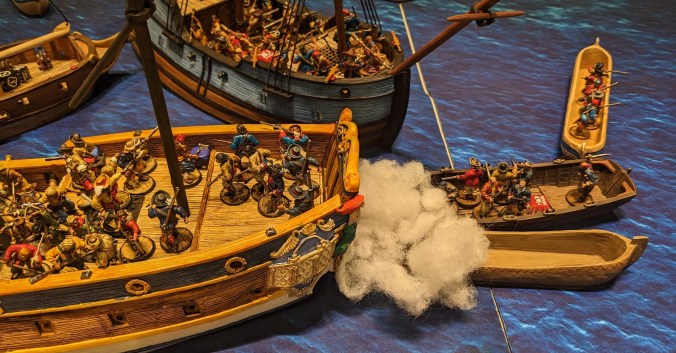
Tactical Suggestions for Using Stinkpots
- If you are attempting to board, stinkpots are amazing. Units in the smoke don’t get Defensive Shots, so you can attack without fear of reprisal.
- Before boarding an enemy ship you can throw stinkpots on an enemy deck from up to 5” away. Depending on the positioning of your ship you can throw smoke from the neighboring deck to the point of boarding. This keeps the units nearest the board free to use 100% of their actions to Charge/Fight.
- Stinkpots are an EXCELLENT option when assaulting fortifications or structures. I personally like to take two units that are equipped with them. This allows you to leapfrog your units moving forward during your assault.
- Units like British Regulars and Enter Ploeg have a low Resolve of 4 which allows them to better ignore the effects of the smoke. This can often allow you to charge through your own smoke and attack an enemy who doesn’t expect it. Units with Indomitable or Tough (if you don’t push) will auto remove a Fatigue at the end of the round so you can ignore the consequences of failure.
- If attacking a ship at sea, targetting a deck with the most cannons or swivels prevents them from being able to fire as they count as Ranged attacks.
- Because they trigger a Fatigue check, targetting units that have a poor Resolve value increases their effectiveness. Against elite units like Forlorn Hope or Enter Ploeg with a low Resolve is less likely to succeed.
Stickpot Fatigue Effectiveness
| Resolve | 4 | 5 | 6 | 7 | 8 |
| Chance of Taking Fatigue | 30% | 40% | 50% | 60% | 70% |
Force Building & Force Builder Tips
Force Builder doesn’t make the options you can take for each unit very clear. As presented it can be confusing that a Unit can take both Explosive upgrade options. Keep in mind that if you look at the Sourcebooks, most units typically cannot take both Explosive upgrades. Typically the Unit details state that you can take Grenadoes OR Firepot/Stinkpot upgrades but not both.
If you select Explosive upgrades that have multiple options, you have to designate which you are taking and which model is carrying them before the game. Force Builder doesn’t include the clarification that any 1 model may only carry 1 type of explosive. The rulebook says:
“A model equipped with Explosives must choose before the battle one of the three types listed below to use for the duration of the battle. A unit may have a mix of different types of Explosives.“
Meaning, you can’t have 1 super bomber guy in a unit that has Grenadoes, Firepots & Stinkpots. But you can have 1 model with each type.
Force Builder also has a “glitch” in it, in that it forces you to always take the maximum number of qualifying models. If you have a 12-model unit and select the option for 1 in 4 to have Grendaoes, it will automatically charge you +12 pts for 3 points. The rules say you “1 out of 4 may add”, not “have to add.” If you only want to add 1 model with Grenadoes, that’s perfectly fine. The workaround is to go to the “Terrain, Fortifications & Gear” section of the builder and select -8 points using the “Force-5” “Force-1” options.

Rules Gotchas and Things to Keep in Mind Related to Explosives
There are a few things that can sometimes be confusing or overlooked. Make sure you keep them in mind while playing with Explosives.
- Throwing Explosives is part of Shoot Action. If you throw them safely it essentially “wastes” the first action for the other models in the unit. There isn’t any way around it. Apparently, everyone just sits and stares at the guy(s) playing with the fuses or watching the balls of death fly through the air.
- The other members of the Unit cannot use other abilities like Marksman or, Deadeye.
- You can make multiple Shoot actions with Explosives, but each additional attack gives you an extra point of Fatigue.
- Explosives are well paired with Brace of Pistolas as you can make multiple attacks without reloading.
- You can’t target two different units/locations with Explosives and Small Arms. This means you can’t split fire or “spread the love” if you have multiple models fielding explosives.

Conclusion
In conclusion, Explosives add excitement to Blood & Plunder and is based on their historical counterparts. I hope this article helped you learn something new about their use in the game. And hopefully, you learned some new strategies & tactics to help to disrupt opponents and give you an edge in your next game.

Additional Content Suggestions
- Stinkpots work well with this strategy: Fast Boarding – Blood & Plunder Sea Force Building Pt 2
- Enter Ploeg Painting Guide
- Stone Tower Fort Battle Report where Explosives are central to the Attacker’s strategy.
Related Products
- Sea Rover’s Practice by Benerson Little. This book includes descriptions of explosives and how they were used.
- Sailor Unit Box – Includes pieces to make pirates using explosives.
- Soldier Unit Box – Can be used to build Grenadiers for army factions (they do not have the same large sacks for grenades, but would hold them in smaller haversack style bags).
- Buccaneer Storming Party – Unit of metal minis containing a mini with explosives
- Enter Ploeg – Unit of metal minis containing a mini with explosives
Pingback: The Spanish Nationality and Factions - Blood & Pigment
Pingback: Complete Guide to Raise the Black Characters for Blood & Punder - Blood & Pigment
Pingback: Fire at Sea! Golden Age Pirates 3rd Place Tournament Force - AdeptiCon 2024