The 2026 Summer of Plunder is just around the corner! One of the elements of the campaign is a team competition to dominate the new world on the campaign map through players and commanders working together to strategize and coordinate troop placement and movement. You can find the full rules for the campaign system here, but in this short post, we will look at the new campaign map and how it functions.
NOTE: Understanding and participating in all the Campaign Map parts of the Summer of Plunder is completely optional. It’s just a fun way to put a theme on things and provide a common goal for teams to work towards. And to get us a Winner and Loser at the end of the campaign! But if you find this confusing and annoying, just skip it and enjoy the games, scenarios, prizes, and goodies!
2026 Summer of Plunder Campaign Map
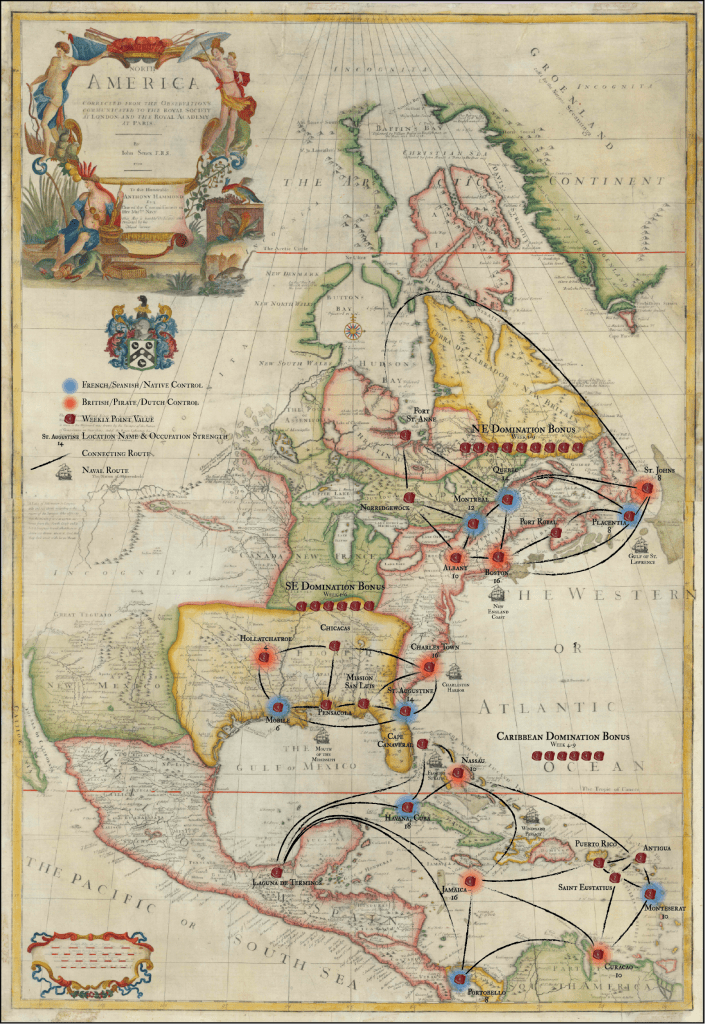
A good bit is going on with this campaign map, so let’s walk through the different elements.
Map Locations
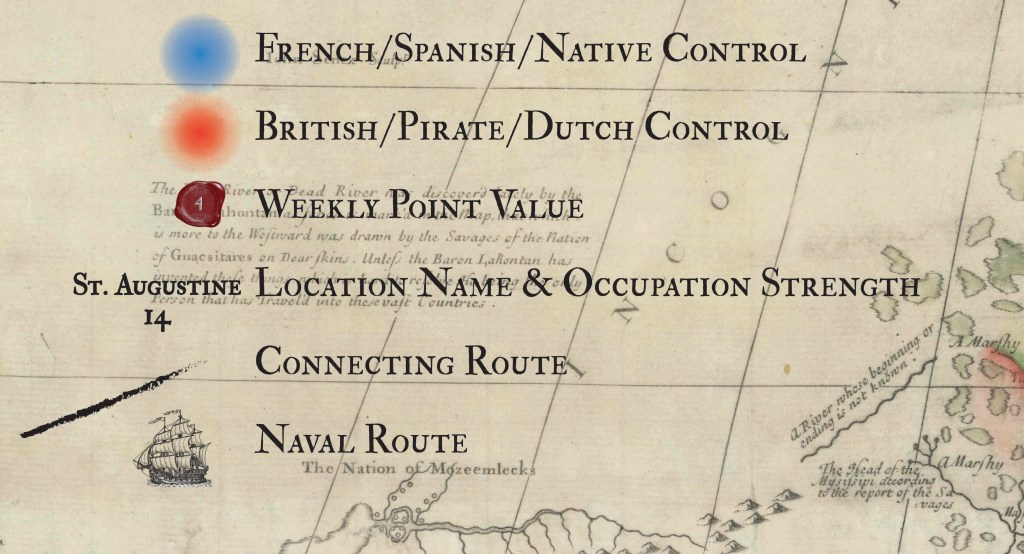
The Campaign Map has a multitude of locations, and each location is marked by a “Firelock Wax Seal” and a location Title.

Within the seal is a number indicating the location’s value: at the end of each campaign week, the team that controls that location will score that many campaign points towards victory at the end of the campaign. Location vay in values from 1pts (outposts/minor colonies/backwater towns) to 8pt (capital cities/major hubs).
The Red and Blue coloring behind locations indicates control. Most locations are uncontrolled at the start of the campaign (no color highlight), but the Blue and Red indicate the teams’ starting locations.
- Red Team: British – Dutch – Pirates
- Blue Team: – French – Spanish – Native American
| Team 1 | |
|---|---|
 | British |
 | Dutch |
 | Pirates |
vs.
| Team 2 | |
|---|---|
 | French |
 | Spanish |
 | Native Americans |
A black number beneath a location’s title marks how many defending “troops” are present. In the example above, Charles Town is held by the British/Dutch/Pirate Alliance, and it is heavily defended with 16 troops. If the French/Spanish/Native alliance were to attack it, they would have to hit it with more than 16 to actually flip it to Blue.
The last element you see is the black charcoal lines between locations, showing the routes that connect them. Alliances may only attack or move into locations they are connected to, which makes certain low‑value points strategically important.

In the example above, Puerto Rico is currently not connected to any French/Spanish/Native alliance locations, so it could not be attacked. Laguna de Terminos is currently connected to Blue or neutral locations only, so it would be unavailable for the British alliance aggression.
To summarize, each location has:
- Title (bold black text)
- Point Value (number in wax seal)
- Alliance Control (Red or Blue)
- Current Defense (number below title)
- Connecting Routes
Sea Lanes
This year, Oak & Iron games will uniquely influence the campaign. Instead of being applied directly to the key point-earning locations on the map, Oak & Iron players will be vying for control of the vital shipping lanes. Holding these lanes enables army movement within theaters, between theaters, and even allows reinforcements to arrive from Europe. Unlike standard locations, Sea Lanes do not carry over from week to week; players contest them anew every week.

There are several Sea Lanes on the map, 2 connected to each Theater (see below). These Sea Lanes can be controlled exclusively through the submission of Oak & Iron games by players every week. Control of these Sea Lanes can let teams redeploy troops and even receive reinforcements. You can read the details here.
How Control of Sea Lanes Affects the Game
- Control of a Harbor (e.g. Charleston Harbor) allows a team to redeploy up to 5 Troops from one location to another within the same theater. So, for example, moving troops from Jamaica to Curacao)
- Control of a Sea Lane in two different Theaters allows movement of up to 5 Troops from one Theater to the other. So, for instance, you could move 5 Troops from the Caribbean to the Northeast Theater.
- If you control BOTH Sea Lanes in one Theater, it gives your Alliance 2 bonus reinforcements from Europe each Turn.
3 Theaters of War on the Campaign Map
The campaign map is divided into three distinct theaters, each representing a major front of Queen Anne’s War. These theaters operate mostly independently, but they are linked by Sea Lanes that allow limited troop movement between them.
These distinct theaters function rather independently. Historically, Queen Anne’s War didn’t unfold in each of these regions on the same timetable. Each front surged or stalled based on supply, diplomacy, and local opportunity. The Campaign Map is designed so it follows the same ebb and flow. Not all 3 theaters will be active for the entire campaign. At the start of the campaign, the Southeastern and Northeastern theaters are in play. After the first 3 weeks, the Caribbean theater will be added as a third theater, but the Southeastern theater will be complete at the end of Week 6.
Timeline of How Theaters Enter and Exit the Campaign
- The Northeastern Theater is active the entire Campaign from Weeks 1 to 9.
- Weeks 1–3: The Northeastern and Southeastern theaters are active.
- Week 4: The Caribbean theater opens as the third active theater. All 3 theaters are active at this point.
- End of Week 6: The Southeastern Theater concludes and is removed from play. (The Northeastern and Caribbean theaters continue.)
| Theater | W1 | W2 | W3 | W4 | W5 | W6 | W7 | W8 | W9 |
|---|---|---|---|---|---|---|---|---|---|
| Northeastern | |||||||||
| Southeastern | |||||||||
| Caribbean |
Domination Bonuses
Each theater offers a Domination Bonus, awarded weekly to the Alliance that controls more than half of the locations in that theater at week’s end.
Why Domination Matters
- In Queen Anne’s War, regional control meant political leverage, safer supply lines, and the ability to dictate where the next blows would fall. Functionally, this is to keep conflicts going in all 3 regions.
- The Domination Bonus represents momentum and that your Alliance is better positioned, better supplied, or simply riding a wave of victories.
- Domination is recalculated every week, so momentum can swing dramatically as players coordinate attacks and defenses.
Southeastern Theater
This is the smallest theater and will be “retired” two-thirds through the campaign (Week 6). Each team starts with one significant location with heavy defenses and one less major location, although the point values and starting defenses are not identical.
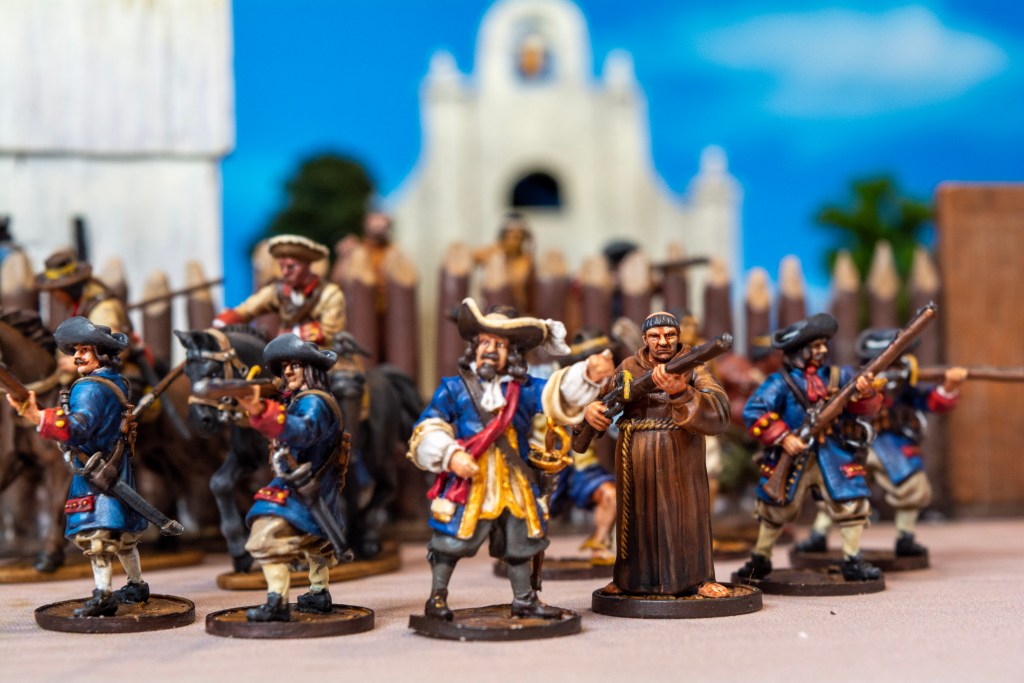
This theater represents the complex conflict between the English, Spanish, Natives and French in the Florida territory. Notable battles and campaigns in this region during Queen Anne’s War include James Moore’s expedition against St. Augustine in 1702, a 1706 attempted invasion of Charles Town by a joint Spanish/French/Native alliance, the Apalachee campaign against the various Spanish Missions, and attacks on Pensacola and Mobile in 1707 and 1709.
The Sortie from Castillo San Marcos and Attack on Charles Town scenarios in the Organized Play Kit is set in this theater.
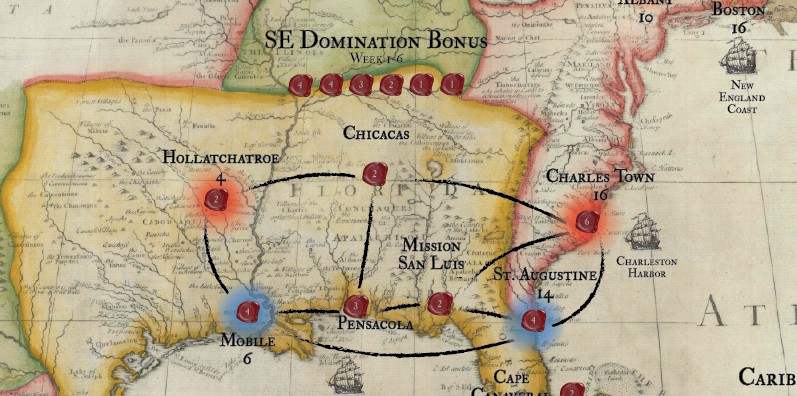
Charles Town, Mobile and St. Augustine are the main prizes in this theater, but the Domination Bonus is significant for the first weeks as well. And since there are only 7 locations, a team could grab that Domination on the first week!
The Domination Bonuses are all different, with the SE theater bonus decreasing at weeks 3, 4, and 5.
Northeastern Theater
Covering New France, Acadia, Newfoundland and New England, is really where the most significant campaigns of Queen Anne’s War were fought. This theater is open throughout the entire 9-week campaign.

There were constant frontier raids between Native tribes and settlers in New England, including the well-known Deerfield Raid, Haverhill Raid, a campaign in Acadia, the siege and capture of Port Royal (not the Jamaican Port Royal), major fighting in Newfoundland, and a large but ill-fated British campaign against Montreal and Quebec in 1711.
The Hatfield Raid scenario in the Organized Play Kit, as well as at least one of the Oak & Iron scenarios from Timber & Sail are set in this Theater.

This Theater features a consistent and valuable Domination Bonus of 4pts to whoever can hold the most territories every week.
Caribbean Theater
This large theater will be inactive at the start of the conflict and will not open up until Week 4 of the campaign. This map has some real bottlenecks, so an Alliance could be cut off from large parts of the map if they are careless.
Historically, during Queen Anne’s War, there were several significant raids on important islands, including a devastating raid on New Providence (Nassau) by the French and Spanish Alliance, and a series of attacks on England’s Leeward Islands led by Iberville in 1706.
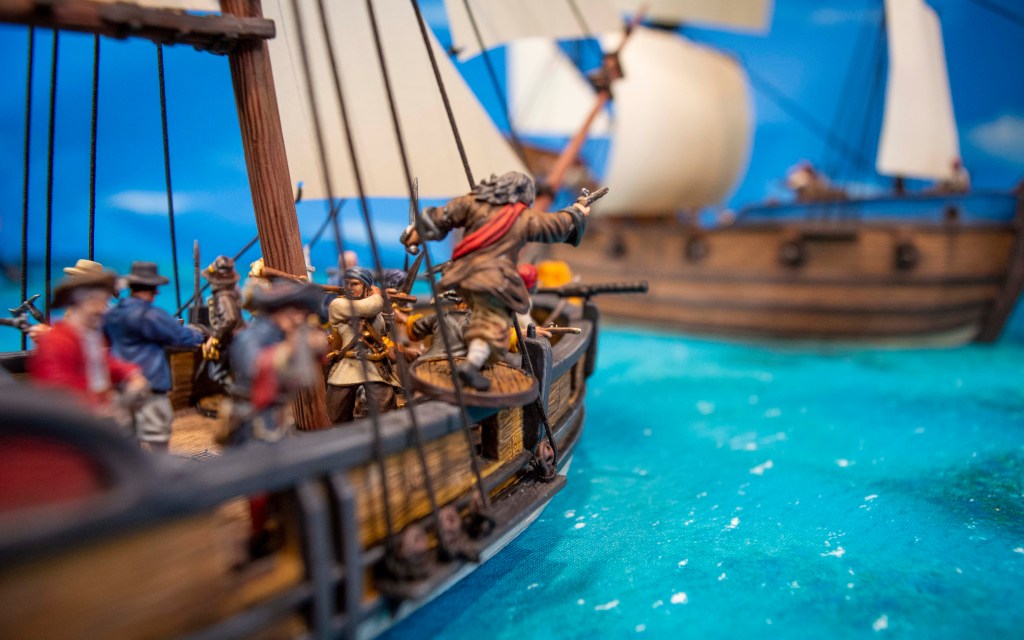
But the real action in the Caribbean happened after Queen Anne’s War, with the rise of piracy between 1715 and 1730. Benjamin Hornigold, Edward Teach, Jack Rackham, Charles Vane, Bartholomew Roberts, Samuel Bellamy, and many more all raided and caused havoc in the Caribbean during these years.
Several of the scenarios from the Organized Play Kit are set in this Theater.
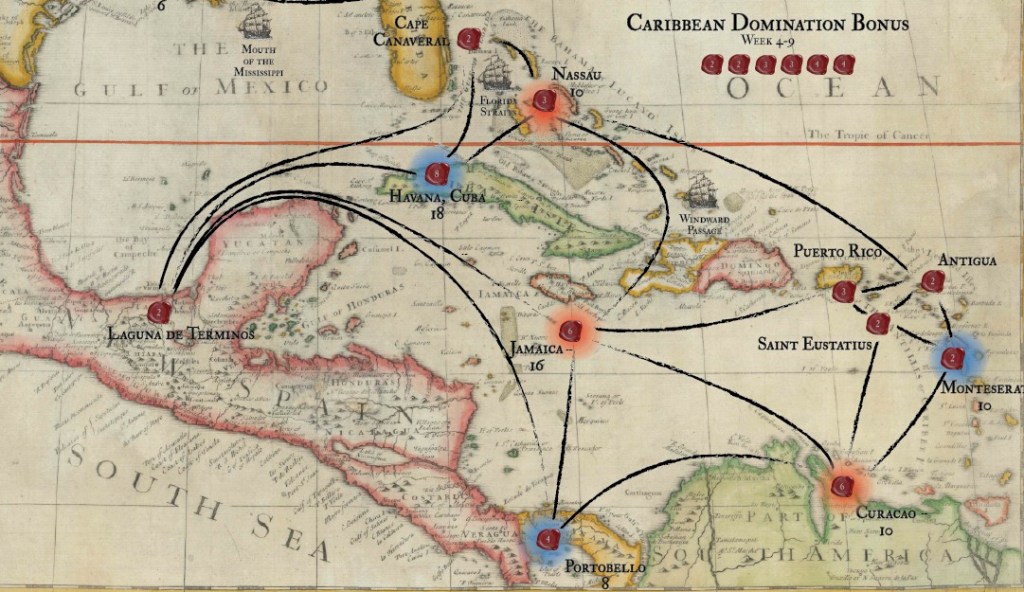
The Domination Bonus ramps up in the Caribbean, becoming more valuable as the campaign nears conclusion.
Map FAQ
What if an alliance gets eliminated from an entire theater?
You can always attack your 2-3 starting locations in each Theater, even if you manage to get knocked out. Please don’t let your team get knocked out of a Theater!
Are locations owned by “Nations” or “Alliances”?
The campaign operates at the Alliance level, with every location held by one Alliance or the other. Each Nation chooses its own attacks and defenses throughout the week, but the real power comes from coordination: all three Nations’ actions are combined at week’s end, and that total is what shifts control on the map.
What happens to Troops in the SE Theater when it is “shut down”?
Those “Troops” on your locations will become unavailable, so it will be prudent to try to use the Oak & Iron Sea Routes to ferry troops out of that theater into more useful locations before the end of Week 6. But if you do it too soon or abandon the region, you may allow your opponents to grab some undefended regions and gain easy points. Strategic decisions are tough and part of the fun!
What do the different region colors on the map mean?
Nothing (for the campaign). This map is a historical map from 1710, and the colors represent how the creator divided the different major territories.
How are Attacks determined?
Basically, players vote on which locations gets Attacked or Defended when they submit a played game for the campaign. The locations voted for most will receive the most points, with each nation having the ability to target 3-4 different locations per week. You can read up on the rest of the Campaign Rules here.
Final Thoughts
If you have questions on the map or this year’s campaign system, you can drop comments on this post, contact us through our Contact page, or through Facebook or Discord.
If you want to understand the whole campaign system, it’s all laid out in more detail in the Rules and Information page for this year’s campaign.

Additional Recommended Reading
- All the Rules & Info for the 2026 Campaign
- 2026 Summer of Plunder Entry Form
- Campaign Map for Summer of Plunder 2026 (will be regularly updated)
- Summer of Plunder 2026 Discord
- Sponsors and Prizes for the 2026 Summer of Plunder