
Blood & Plunder is the flagship product for Firelock Games. It is a 28mm skirmish game set in the Colonial Americas during the Golden Age of Piracy of the 17th and early 18th Centuries. Port Royal is set in a smaller slice of the same era. It focuses on events following a massive earthquake and tsunami that hit the city of Port Royal in 1692. Port Royal uses many of the unit stats and concepts of Blood & Plunder but is a very different game in terms of mechanics.
In prepping for and thinking about this article I wasn’t sure the best route to tackle it to make it most beneficial for the reader. Most of the content in the this Kickstarter has been covered by other content creators. There is already a basic video demo of the gameplay. Rather than do a flat rehash of existing content, in this article we’re going to run through the similarities and differences in the two games of Blood & Plunder and Port Royal at a high level to give you and idea of how the games compare.
Size and Scope of the Game:
- Port Royal is a smaller skirmish game using 5-8 independent Models per player. You typically have 1-2 Officers
- The default board size is a 2’x2′ board for a standard game.
- Sea Games are not currently available, but ships are in the plans for a future expansion.

- Blood & Plunder is a squad-based skirmish game with 3-6 squads totaling 15-50+ total models per player.
- Land and Amphibious games play on a 3’x3′ or 4’x4′ board
- Sea Games play on a 3’x3′, 4’x4′ or ideally a 4’x6′ board.

Miniatures:
- Blood & Plunder and Port Royal use the EXACT SAME minis! So if you have Blood & Plunder, you likely already Have all the minis you need to play. This a an awesome perk for fans of both games.
- The “Box of Plunder” from the Raise the Black Kickstarter is back as part of a core pledge! So fans of Blood & Plunder that missed it previously have another opportunity to grab this go round. It has excellent options for some unique models like an 18th Century Officer, a Blackbeard alternate pose, a Spiritual Leader model and lots of other goodies. It is DEFINITELY worth picking up if you don’t already have it! Hopefully they’ll include it as an add-on towards the end of the campaign.

New Models in Port Royal
Port Royal is adding several new models that fit the new officers for every faction. These come with unique weapon customization options. Each of them comes with 6 head options and a host of weapon and character customization options.
A Customizable Character Sprue
This model will fit the role of a LARGE number of the Officer models in the game. He looks like a rehash of the Reformado from Blood & Plunder with the head and hands removed for customizability. To be honest, as an experienced modeler and kitbasher, this looks a little tricky. The pose may be difficult to customize very far. (I hope I’m wrong!) Still he comes with access to multiple new heads and weapons allowing you build for almost any national faction in the game.


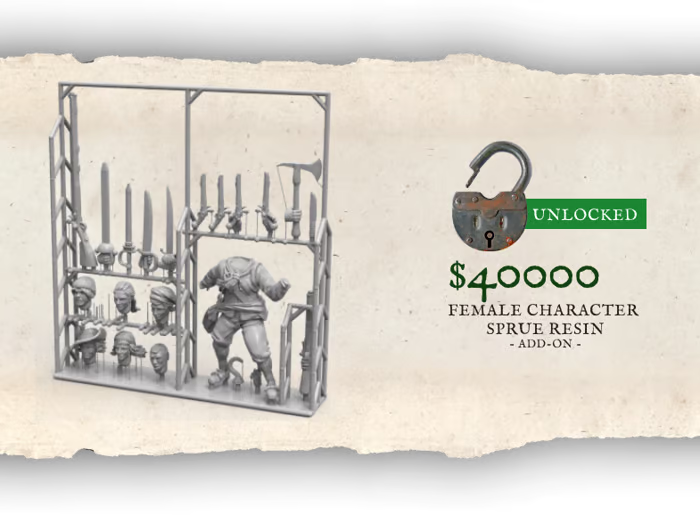
The Female Sailor
The Female Sailor is back with some new options and will no doubt be a hot seller. Unfortunately, it is difficult to find female sailor models that aren’t scantily clad or excessively buxom and curvy ladies. Firelock nailed it with this character. And with the variety of heads, you can swap a few of them with your Sailor, Militia, Soldier or even Cavalry models for Blood & Plunder to have a full female warband/crew!
A Maroon Character
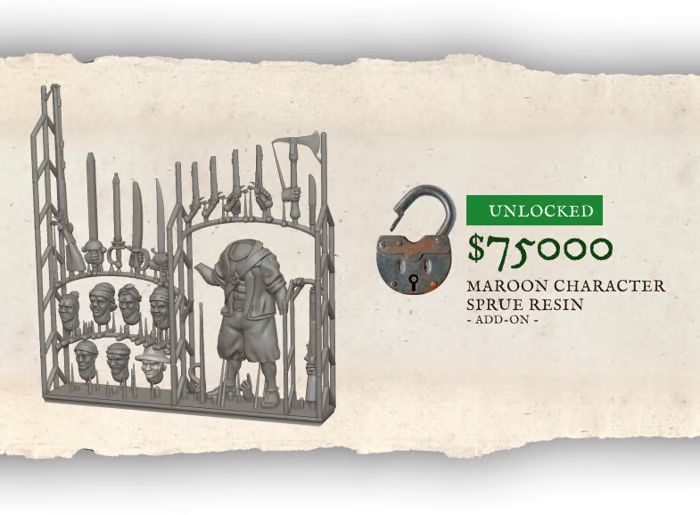
The new Maroon Character looks quite a bit like Black Caesar from the Pirates of Legend pack with a bit of a facelift on his clothing. It appears that to come with a rehash of the standard African heads in the Sailors, Militia, and Native American boxes currently available for Blood & Plunder. However, there aren’t enough in the other packs so these 7 heads will help you flesh out your Maroons force for Blood & Plunder.
Native American Leader Model
The Natives get a new Commander character. This pose if similar to other models but is probably the most unique from existing models in the Natives faction available to Blood & Plunder.
On the current iteration of the sprue we see:
- 5 heads, all of the Caribbean variety
- It appears that the sprue currently has the same weapon options as the other commanders but it seems likely they will be updated to more Native-appropriate options before production starts. Hopefully we’ll get to see that before the end of the campaign. If not I’ve been told that it will be fixed post close of the campaign

Wild Beast Models
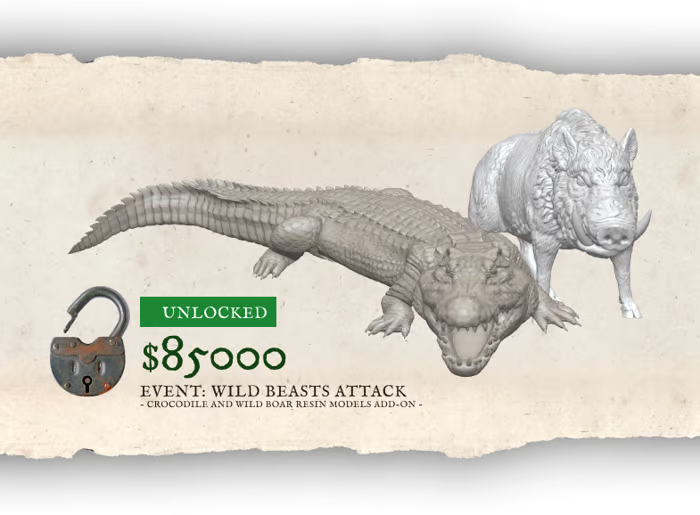
The “Wild Beasts Attack” stretch goal was a bit of a shock to me. I like the concept and it is causing quite a stir of speculation and excitement on Facebook & Discord. I think they are awesome models and will definitely be of use in some capacity, if only for cool factor on the board, but … in reality they don’t have a massive impact on the game.
They can appear in the game in 1 of 3 ways:
- They can appear as part of 1 random Event if you tie in initiative. They appear, attack and disappear immediately so they aren’t really “in the game”.
- The “Exploration Phase” of the game. It’s a section that happens between games. It’s a simple roll on a chart and involves zero actual game play. So sadly the models won’t make any appearances on the table.
- Optional Hazardous Terrain on the board. If a Character ends a move in and/or has moved through terrain they have to take a Damage Test. It’s up to you to be creative as to what that Hazardous Terrain looks like on your board. Perhaps it is quicksand, poisonous plants, unstable ruins, or if you want to use the nifty models, a crocodile-infested pond or a wild boar feasting on the dead.
You do have the option of adding
Unit Size & Makeup for Force Building
Blood & Plunder
- 1 Commander
- 1 Character (Fighting Men/Hostage or Advisor) per 50 pts
- Max of 1 Support Unit per 2 Core Units
- Squad size varies by game size
- Land Games are typically 150-200 pts
- Sea Games are typically 200-250 pts
- There are 7 Nations, 99 Factions and dozens of unit types across each of them.
Port Royal
- Must include at least 1 Officer of a Company
- Any number of Crew Characters
- You may not have twice as many Officer Characters as Crew Characters
- Max 5 of any individual Character type (e.g. 5 Sea Dogs or 5 Boucaniers)
- Max 15 total Characters
- Land games use 30 Pieces of Eight (different than the points in B&P)
- Sea Games – don’t exist but are coming in a future expansion.56
- There are 7 Company options each with 4 Officers and 4 Crew Units.
- .Jamaican Pirates
- French Buccaneers
- Spanish Guarda Costa
- Carib Raiders
- Maroons
- Forces of the English Crown
- Dutch Kapers
- Units are MUCH more configurable than Blood & Plunder.

Firelock has put out an solid preview of all 7 factions in the game in the updates for the Kickstarter. I highly recommend you check them out for more details. There are TONS of spoilers in these two updates!
- Jamaican Pirates
- French Buccaneers
- Maroons
- Forces of the Crown
- Spanish Guarda Costa
- Carib Raiders
- Dutch Kapers
Initiative Mechanics
This is an area where the games differ quite a bit. One thing I have always loved about Firelock Games is their addition of strategy and tactics to the Initiative System. I personally HATE games that are a simple roll off or generic assignment of who goes first.
Blood & Plunder uses a deck of playing cards to determine initiative.
The suit and number of the card determine which Models activate first and how many actions they get per round.
This for me is one of the absolute beauties of the game and it’s one of the chief selling points I use in teaching the game to new players. It’s what initially drew me to the game. Its unique to the game and offers a creative method of adding strategy as opposed to most games method of I Go You Go (IGOUGO) or a simple die roll to determine who goes first.

Port Royal involves a different method that uses a bidding system allowing players to spend some of their Fortune Points (different than B&P).
- At the start of a Turn each player generates 6 Fortune Points if their Infamy ratings are equal. With a +1 Fortune Point for every 5 points of Infamy difference.
- Players secretly decide to roll 0-3 D10 dice. Each D10 rolled reduces the player’s Fortune Point pool by 1.
- Players roll their chosen number of dice. The highest single D10 result determines the first Active Player.
- In case of a tie, the player who rolled more dice becomes the Active Player. If still tied, re-roll all dice.

Random Events
Adding a little chaos to the game can make it fun, interesting and variable.
- Blood & Plunder generates a random event when one player draws a “Joker” from the deck. A D10 is then rolled on an event table for the game based on the theater/expansion book used.
- In Port Royal If players players roll a tie on initiative it triggers a random event, determined by rolling on the Event Table. During the playtest phase there were only 10 events, but there are rumors of it possibly expanding to as many as 100 different events.

Fortune Points
Fortune Points mean two VERY different things in these games.
In Blood & Plunder you typically get 3 per game (without special abilities/upgrades) and when they are gone they are gone. You can use them to do one of 3 options:
- You can re-roll all dice rolled for a Test, including successe
- Replace you iniatitive card hand
- Allow your Commnader to Cheat Death and move to another unit rather than be killed.

In Port Royal Fortune Points are generated every turn and can be used to do the following:
- They can be used to bid for Initiative to help you go first.
- When activating a Character (not during a Reaction), it may use a single Fortune to take 1 additional action (a 3-action limit still applies).
- Reroll all dice rolled for a Test, including successes.
- Damage Tests cannot be re-rolled using Fortune, but during a Damage Test, a Character can spend a Fortune Point to make damage tests more successful
- Some Faction and Character abilities allow Fortune Points to do unique actions like removing Fatigue, taking Free Moves, or a new Conceal action to minimize incoming fire.
Action Mechanics
Many of the core action mechanics are very similar between the games. Players of Blood & Plunder will have no issue changing over to the new game system.
Blood & Plunder
- Its Initiative Card and Experience Level determines the number of actions a Model can take.
- Commanders & special Characters can give models additional actions.
- Characters cannot go above 3 Actions per Activation
- Some faction bonuses and unit special abilities give Free Actions
- 2 or more Fatigue reduces your number of Actions by 1
Port Royal
- Every Character gets 2 Actions per Activation, but you may spend a Fortune for a bonus action
- Officers can give models additional actions.
- Characters cannot go above 3 Actions per Activation
- Some faction bonuses and unit special abilities give Free Actions
- 2 or more Fatigue reduces your number of Actions by 1

Combat Mechanics
The combat system is familiar between games in that the core attributes of Fight, Shoot, and Skill for a model remain the same. However, death and damage are significantly different. In Blood & Plunder, any unsaved hit simply kills a model. Port Royal adds a new damage and wound mechanic to the game.
When a Character is successfully attacked or potentially injured (e.g., falling or an event) it takes a Damage Test with a target of 10. All Weapons in the game have a bonus or penalty. (e.g. Musket -2, Sword -1). Fatigue also has a negative effect (e.g., 2 Fatigue = -2). If the result exceeds 10, the Character is removed as a casualty. If it fails the target gains 1 point of Fatigue.
However, Characters removed during a game of Port Royal aren’t necessarily dead. When playing in campaign mode, at the end of a game you roll on an Injury Table to determine if characters a killed, wounded, or suffer some lasting injury that affects their stats and abilities.

Reactions
Reactions are an integral part of Port Royal and play a massive role in the strategy of the game. After the Active Player completes Actions, the Reactive Player may React with one of its Characters. Reactions require an Experience Test to succeed. Failure means they can’t React. If successful the Character may take a single action of any kind.
Reactions help break up the IGOUGO framework and keep both players engaged in the turn. They also can create some creative offensive and defensive tactics where you are moving in position to trigger a reaction on your Opponent’s turn. This Reaction mechanic is definitely where the game shines. It might take new players a bit to grasp the full might of their power, but it is an excellent system. It adds a level of planning akin to Chess where you have to be thinking multiple moves ahead of the current action/turn, which I personally LOVE in a game.

Resolve Tests
Resolve tests only occur in Port Royal if you fail the Damage Test. Roll a Resolve Test for each failed Damage Test:
- Failed Resolve Test: Gain 1 additional point of Fatigue.
- Passed Resolve Test: No further effect.
- Critical Failure on Resolve Test: Opposing Player can move the Character 2″ in any direction or force an immediate Go Prone action.
Fatigue
- Both systems include a Fatigue mechanic for morale. And they are very similar. To reflect the smaller unit size, Port Royal Characters retreat at 6 Fatigue instead of 7.
- Shaken tokens and the effects remain largely the same.
- If you have 2 or more Fatigue you have a +2 to a Reaction Test.
Weapons
Weapons are one of the areas where Port Royal also differs greatly from Blood & Plunder. In Plunder all units are preassigned weapons and equipment. Characters in Port Royal are blank slates. Each company has access to Common and Rare equipment that fits their national flavor. This is an interesting dynamic that lets you customize and build your forces on a very granular level
Weapons also now have Traits (Two-handed, Accurate, or Blast) that help make attributes more common and easier to learn. However, gone are the simple 4” range bands of Plunder. Instead, each Ranged weapon now has one of two range types and each type has different range bands. It adds some complication, but it is a short learning curve.
Close Range Weapons:
- Short range: Target within 2″.
- Medium range: Target within 4″.
- Long range: Target between 4″ and 8″.
- Maximum range: 8″.
Long Range Weapons:
- Short range: Target within 4″.
- Medium range: Target within 8″.
- Long range: Target between 8″ and 12″.
- Maximum range: 12″.
If playing in Campaign Mode, weapons can be sold between game sessions and Characters can upgrade gear. There are also Legendary items that can be recovered from exploration missions or as loot during a game.
Campaign Mode
Campaign Mode is where this game REALLY shines. It’s what I am most excited about and what has the most potential to make the game FUN! Rather than just playing a one of game, you can play a series of games that chain together in a longer narrative.
After every physical game you play there is a series of phases that happen between rounds.
- Loot acquired during the game can be used to purchase new equipment, replace fallen crew, or hire new members.
- Your Officers and Crew men may suffer injuries that limit their effectiveness or perhaps give the scars and knowledge to improve their future success.
- Your Characters will gain experience and develop new skills.
- There is an Exploration Phase in which you can choose to send your crew out to further explore and loot the area. This is a risk/reward mechanic that can net you rare items, treasure and perks… or lead to crew members being attacked or injured. You may find a treasure map or encounter a surgeon or priest wandering through the rubble.
This area of the game has tons of potential to add thematic fun and chaos to your game sessions. It’s an area that will no doubt appeal to miniature wargamers and role-players alike!

Gameplay Modes
Port Royal has a number of different ways to play. Mike Tuñez likes to say that as a game designer his job is to tell you how to have fun but at the same time not box you in too much. He doesn’t disappoint with this game. It is a great “sandbox” type game that gives you all the tools and mechanics for creativity and leaves it to you one what you want to build and how you want to build.
Multiplayer Games
There are currently 4 different ways to play multi-player games in Port Royal. The style of play allows you to play with 2-4 players or possibly more, but most game rounds are limited to 4 players at a time..
Team Multiplayer Games: In team-based multiplayer games, players are divided into two teams with similar Infamy Ratings. Each player generates their own Fortune Points, and any bonus points from Infamy disparities are shared among teammates. Players roll for independent Initiatives and take turns as the Active Player from highest to lowest, while others act as Reactive Players. Reactions are limited to one per Character activation, and players cannot react to their teammates’ actions. When multiple opponents can react, they must decide who will attempt the reaction.

Multiplayer Free for All Games: In Free for All games, players track their Initiative scores and take turns as the Active Player. Once a player completes all their activations, they move to the last place in the Initiative order. When an action is completed, the Reactive Player with the highest Initiative has the first opportunity to react. If they pass, the next highest Initiative player gets the chance, and so on. This setup requires minor adjustments to the Reaction rules, but all other rules remain consistent with standard gameplay.
Cooperative Games: Cooperative (co-op) games are designed for groups of 4 players or fewer, operating similarly to Solo games with additional rules. Each player creates a Company using 15 points, from the same or different factions. One player is designated as the Commander, with their Company’s highest-ranking Officer serving as the overall Commander. This player rolls the Initiative Dice and decides when to use Fortune points, ideally in collaboration with the team.
Gamemastered Games: This involves a game master (GM) who leads players through a campaign, creating a rich narrative that includes traps, ambushes, secret treasures, and surprising allies. The GM sets up the terrain, selects scenarios, and builds and controls the opposing forces. This offers a cooperative or single-player experience with a greater focus on storytelling, making them unique compared to head-to-head or solo games.

Solo Play Rules
Solo games are simple and straightforward. You create an opposing force using the rules in the AI Opposing Forces section, then play a game against that force with your company. You can also link several solo games into a full campaign against one or more AI opponents.
There are rules for the order of operations for driving the AI player. When one of the AI Characters activates there is an element of randomness introduced by a deck of cards and the current number of strike points between you and the AI player. The actions fall into three categories Aggressive, Tactical, and Fall Back/Retreat.

Optional rules allow for 5 different commander profiles to guide the actions of the commanders along different paths.
I’ve only played a single solo game and the mechanics are interesting. It will be interesting to see how it plays out with more testing, but this section of the game has excellent potential for a broad spectrum of players. Being a smaller game, it’s much easier to buy into and even with a single box of 12 minis you have enough minis for both players.
Miscellaneous Items in Port Royal that are different than Blood & Plunder
- There are currently no Cavalry Units in Port Royal
- Ships & Boats don’t yet exist in Port Royal but are planned in a future expansion.
- Structures have been simplified, again due to the move from squads to single models. Movement and combat within structures are much more “what you see is what you get” rather than abstract in Blood & Plunder.
- Control zones have been reduced from 3” to 1”.
- Melee attacks can happen at a range of 0” to 3” (daggers to Pikes)
- Because the game happens in a ruined city and there is more focus on vertical structures there are new rules for Jumping and Falling.

Conclusion
Wow! You made it…. (or cheated and skipped to the end). Congrats on making it to the end of this phase of the campaign. But unfortunately the princess in another castle (ruin).
I hope you learned something new and are excited about the game of Port Royal. If you are an existing Blood & Plunder player, this will be an EXCELLENT supplemental game and a fun break from a standard miniatures game. If you aren’t a Blood & Plunder player and are just interested in pirates, this game is also a great fit for you. It’s got a low barrier to entry in terms of models and a light ruleset.
If you haven’t yet, pledged, I’d seriously take a deeper look at the game on Kickstarter. There is definitely some piratical fun available for players of all types and playstyles.
If you’ve not yet joined, there is already an active Facebook Group and a community of wargamers already discussing the game and spitting out ideas, terrain and minis!
Check out the Port Royal Kickstarter today!
Article by Jason Klotz
Additional Content Suggestions
- Port Royal Facebook Group
- Firelock Games Discord Group with a channel for Port Royal
- 2+ Tough does a preview of Port Royal and talks about his playtesting experience
- Get a quick play demo of the Port Royal game by Mike Tuñez on YouTube
- OnTableTop does an in-depth interview with Mike about the game’s mechanics